Sanding Speeds


When sanding timber, another tool in your finishing arsenal is the variable speed control on your random orbital sander.

When I’m talking to clients who are looking at buying a sander, one of the things I’ll talk about very early in the discussion is the benefit of speed control when sanding.
The main points that you need to remember are, the coarser the paper the higher the speed; the finer the paper, the slower the speed.

Coarse paper on slow speed tends to dig in and ‘bite’ the work, which can lead to scratches, and swirls, which are bloody hard to get out. Coarse paper on high speed tends to ‘skim’ over the work and while it may take a little longer you’ll achieve a more controlled result.

Fine paper at full  speed  “floats” over the surface requiring more pressure to achieve any result, and more pressure increases the risk of swirl marks.  Fine paper at slow speed has even contact with the work piece and requires minimal pressure to achieve a top result.

When you start sanding and are using, for instance a 40 or  60-grit paper,  start with the sander on speed 6.  As you start moving into progressively finer grades, gradually begin to lower the sander speed. Use the chart below as a rough guide for sander speed related to sanding grit.

Sanding grit.     Speed
40.                       6
60.                        6
80.                       6
120.                       5
150.                       5
180.                       5
240.                       4
320.                      4
400.                      3
500.                       3
800.                       2
1000.                     2
1200.                    1
1500 & finer           1

This chart is a suggested range only and results can vary depending on the type of timber that you choose and the mechanics of your sander.

 (150mm diameter abrasives up to  4000 grit are available from  most Festool dealers. Papers listed here are from the Brilliant 2 and the Titan range.)

The transition point when sanding is 400-grit.

This is the stage where you stop sanding the timber and start burnishing it. From 400 up you’ll start to see the surface of the timber develop and become smoother with every sanding stage that you complete.

 Don’t forget to feel the timber as you sand it so that you become more familiar with how each sanding grade contributes to the overall finish if the surface.   When you reach 1200 grit, you should see the timber surface begin to develop a lovely lustre and the surface will begin to shine. This happens, because the flour, (really, really fine sawdust) which is created by the super fine grits that we have been using is filling and closing the pore of the wood, burnishing the surface and giving us this glass like finish.

As an exercise, try using this method on different species of timbers to see how their various surfaces develop. I’ve used this method on both hard and softwoods with consistently good results
Jump in and have a go at this sanding method.  There are many ways to finish and use your sander and what I’ve discussed here is the method that works for me.

Drop me an email if there’s and areas you need clarification on or, let me know how you found this method.

New Dust Extractor, Protool VCP 260 E L A/C

Hi All,

I had a chance to see the new Protool dust extractor from Tooltechnic Systems, the home of Festool. The new VCP26o is a very impressive machine and has identical power and capacity to the Festool CT 26. A major difference is the addition of  a modified form of

the auto clean function that is on the Festool CT36AC. The autoclean on the VCP260 ac , when activated, cleans the filters at preset intervals of 10 seconds which helps the extractor cope with such challenging materials such as plaster, concrete and stone.

When in auto clean mode it’s recommended that you use the plastic liner to collect the dust. Alternatively there is a self cleaning bag, similar to the bag in the CT26, but with a larger pore to allow the bag to cope better with concrete, stone and plaster dust. The standard bags for the CT26 fit the VCP 260 AC.

When using the VCP260 with timber,  in applications such as routing and sanding you can turn off the autoclean mode and use the standard self clean bags.

As with the CT 26 and 36 there is a removable plate which allows you add a continuous supply powerpoint to the front panel of the extractor. You cannot add another tool actuated power port to the VCP260 AC

I was  really impressed with the dimensions of  the VCP260 The overall size is 673mm long X 365mm wide X 455mm high. The low profile means the extractor is more stable on uneven surfaces and also means it will easily fit under the hardtop of most ute’s and  into most vans.

The VCP260 comes with a 36mm antistatic hose in the scope of delivers as well as a rear mounted tool holder. There is reducing sleeve available as an extra which allows tools with a 27mm port to be nused with the 36mm hose.

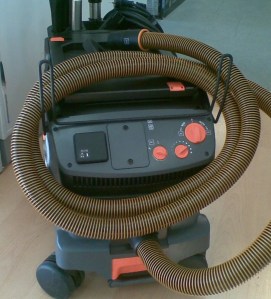
The VCP 260 as shown in these images is fitted with a sys dock. This is not included in the scope of delivery and is available as an accessory.

One other cool new feature is the inbuilt hose holder, as shown in this photo. The hose is securely held in place when the extractor is transported and there’s no more battling to get a 36mm diameter hose into a hose garage.

This is an impressive all rounder which will tick all the boxes for the tradie who works in a variety of fields and is looking for one machine to suit all his needs.

We’ll have it in store next week so If you want more information either post a comment or send me an email.

Cheers

Bryan

Simple Sliding Dovetails

sliding dovetails master pdf

Hi All,

Please follow the link  shown here for a quick tutorial of the method I’m using to make sliding dovetails. I’ve used  extensively and found that with practise you can make them quickly and most important, accurately.

This, by no means is the only way to make sliding dovetails but for me it works.

If you’ve got any questions either leave a comment or shoot me an email.

Hope you enjoy it

Cheers

Bryan

Work in Progress

Hi all,
It’s been a while since I updated this blog and for this I apologise, but life sometimes throws you a few curve balls. Between family commitments, a death in the family, and the bloody flu I’m scratching my head as to where this years gone.

Anyway, enough of that. I’m nearly finished an article on the Rotex, sanding techniques and an easy way to make sliding dovetails. I’ll also be giving you all heads up on new tools as they come out on the market.
There’s now an email subscription link on the page so be sure to register so you’ll get an automatic update when I add new content.
As always, comments and questions are appreciated and if you’ve got a problem with a project, drop me an email and we’ll see if we can nut it out.
Anyway, thats all for now.

Cheers

Bryan

Stair Building with the Festool MFS Router Jig

MFS Stair Article

Hi All,

Attached to this post please find a link to an article on stair building using the Festool MFS Router Template system to rout both the treads and risers into the stringers at the same time.

I wrote this when I was running training sessions at Festool and the participants found it very useful.

The MFS system is a little tricky to get your head around but when you get the knack of it, you’ll find it invaluable.

It’ll work with any router which accepts template guides, (copy rings)

Any comments or questions are always appreciates

Cheers

Bryan


Hello world!

Well, I’ve finally done it, made my first foray into the blogosphere. For better or worse here we go.

This blog is all about wood, woodworking, tools and other cool stuff.  I’ve been a passionate woodie for over 25 years and and now working full time selling power tools for one of Melbourne‘s premium tool shops. Over the years I’ve built and sold furniture full time , run a picture framing gallery and have been the national training manager for a major power tool company.

I want to keep this blog interesting, as well as informative and as well  as some technical and how to articles I’ll also be posting info on new tools as we se them in the shop.

I’ll also be trying to offer some objective advice on what power tools are  good and what, well, maybe needs a bit more development, so you can go to the tool shop with confidence when it’s time to upgrade the kit.

Above all else, please ask questions. As a trainer whose run too many power tool and woodwork training sessions to think about, I always remember the classes whose participants asked lots of questions as being the most enjoyable sessions.

Anyway guys, thats all for now

Cheers

B

Create a free website or blog at WordPress.com.

Up ↑