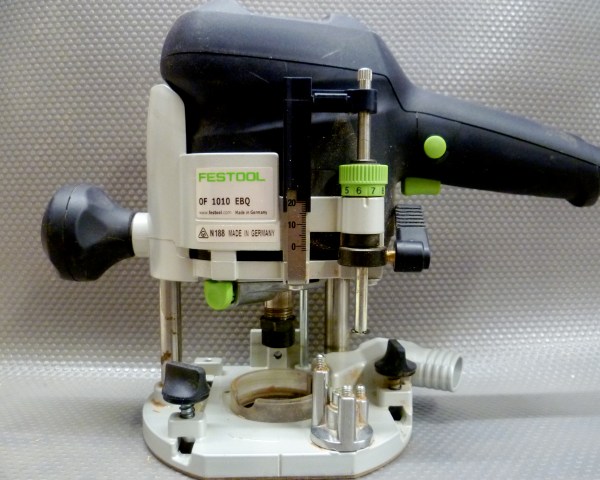
How to get the most from your Festool OF1010 Router

The Festool OF 1010 Part 1


Hi Guys

Well, here’s the first part of the series of router articles that I’ll be uploading over the next few weeks.

The articles will be quite comprehensive, so on machines where there are lots of features to cover I’ll break them up into two parts. Part 1 of the OF1010  covers the basics and details all of the important parts up to the depth stop mechanism.

Part 2 which should be up next week will cover using the depth turret, copy rings, changing bases and accessories. I’ll also be including practical exercises which will give you an idea of how to create some common joints with the  OF1010.

I’m working on a series of articles which will cover template routing and how to make things such as hinge jigs and other useful jigs. Before these articles are uploaded I’ll be covering the features, functions and ideal applications of a number of popular routers and trimmers on the market. Please take the time to read these as they’ll all help to give you a greater understanding of how your machine works. Before you can begin to get the most from your Router you need a thorough understanding of all its features and functions.

Drop me a line if you have any questions about specific machines and as usual, your questions and comments are always appreciated.

to read the full OF1010 article please click here  Getting the most from your OF1010

Have fun and be safe,

Cheers for now

Bryan


Tiny Things

I had to reblog Stu’s post. This is an awesome piece of work and shows what can be done when you really push woodworking to its limits.

For more out of this world carving have a look at miracle chicken miniatures here.
Be inspired and have fun
Cheers
Bryan

Stuart's avatarStu's Shed

Seems to me these days, that not only am I burning the candle at both ends, but I’ve somehow had to light it in the middle as well. I need to get it under control again soon: it is unsustainable, and my post quality and quantity recently is a direct reflection of that.

In the meantime, as a seque back to what I wanted to show: found this image recently, don’t have any detail about it at all unfortunately. But if you are burning the midnight oil, or burning the candle at both ends, you could use one of these to ignite it

20120301-005544.jpg

Cool huh!

View original post

My Cordless Mitre Saw

The Nobex Proman

Sometimes you don’t need a power cord……..

During my recent break from the Monday to Friday job I was able to get enough time to cross another project off my very long home renovation to do list.

When we moved in to our current abode we were faced with the problem of bugger all space in the pantry, so in the tried and true fashion of woodies everywhere I set to work one weekend and constructed a large addition to the existing pantry.

With six large sliding drawers and six fixed shelves and constructed from melamine coated MDF, the new unit was spacious, but with the MDF edges of the carcass and drawers visible it was butt ugly. My intention was to clad the exposed edges and drawer faces in solid timber but as with all good intentions they can sometimes get a bit delayed.

That was three years ago…….

Fast forward to 2012 and with free time on my hands and about 100 lineal meters of recycled  Sydney Blue Gum floorboards to play with, I plunged headlong into the task at hand.

Once I’d made the drawer faces I ripped the trim to about 2mm larger all round then hand planed it to the required size.

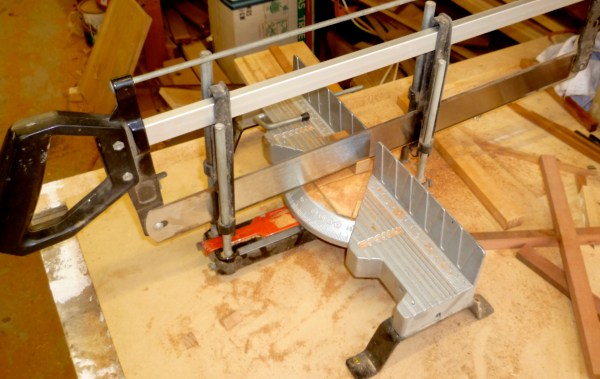
I did a couple of test cuts with my Bosch mitre saw but as Sydney Blue Gum is fairly brittle and my saw blade was a bit coarse the end result was not brilliant. Rather than go out and spend $100+ on a new 80 tooth blade I turned to old faithful, my Nobex Proman mitre saw.

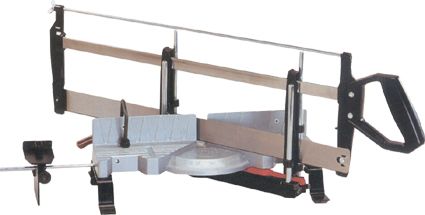
I bought this saw over 12 years ago when I was making a lot of bespoke picture frames, (that’s another story), and it’s never let me down. With a 32 tpi blade fitted it  made short work of all the capping and trim for this project.

The Nobex is perfect or when you need to  get up close and personal to the without risking life and limb, or as shown above you  need only to trim a small amount off.

To watch a video of the Proman please click here.

If you’re interested and want to find out more information about where to get a Proman, please click here.    http://www.justtools.com.au/prod4710.htm

Thats all for now guys,

As always, your comments and questions are appreciated

Cheers

Bryan

Update on Festool production video

Sorry Guys,

I’ve just received an email from Festool advising me that the video I posted yesterday is not allowed to be shown on You Tube and that I ran the risk of breach of copyright, so consequently it has been removed.

I’m working on my next series of posts which cover routers and template routing.

As always, your comments and questions are appreciated

Cheers

//

Bryan

Festool Factory Video

Hi All,

I was cleaning up some old files and found this video which I used in all my training sessions when I was at Festool.

It gives an overview of the Festool production facility in Neidlingen (Southern Germany) and takes you through the production of a Kapex

Enjoy

Cheers
//

Bryan

The New Dewalt 18v Cordless

New beginnings for Dewalt.

Hi All,

I recently had the chance to have a good play with the new cordless hammer drill, drill driver and impact driver from Dewalt.

As one who wouldn’t normally touch the brand due to the turbulent relationship that we’ve had in the past, I was more than surprised by how good these new tools are.

Read my full article here, Is this the new Dewalt, and as always, stay in touch and let me know if you have any thoughts or comments on the article.

Cheers for now,
//
Bryan

My Two Favorite Hand Planes

20120131-151249.jpg

I have a real passion for hand planes and have quite a good collection, but when It comes down to it the two planes pictures here are the ones I reach for 90% of the time.

The larger of the two is an antique smoothing plane made by Stewart Spiers, from Ayr Scotland.
The smaller of the two is a Lie Nielsen skew angle block plane.

Cheers,
//

Bryan

A Cautionary Tale..

I’m a major fan of Christopher Schwartz’s, lost art press blog and was amused, if that’s the correct word, to read of his nasty encounter with black walnut, (see, The Nasty Nut).
It reminded me of how I developed a healthy distrust of white and red cedar.

It happened back in September 2008 whilst I was working at the working wood show in Canberra. After discussions with the dealer we were doing the show with, our focus for this event was demonstrating the new Vac Sys vacuum clamp system as well as the Rotex and ETS sanders.
From previous shows i’d done earlier in the year I found the the best way to demonstrate the Vac Sys was to fix the Vac Sys to a MFT 3 table then put a slab of timber, borrowed from one of the timber merchants at the show, then use the rotex to sand and polish the slab to a mirror finish. ( See blog on “how to get the most from your rotex” for the technique)
It was a mutually beneficial arrangement as we had a continuous supply of timber to demonstrate on and the timber merchant got a finished slab he could sell for a higher price.
Well, once the test centre stand was set up I went to explore the timber area and soon met up with the boys from Cedarworks in NSW who agreed to let me use their timber. I’d never used this technique on cedar before and was interested in how it would work.
The show began on the Friday which was a blur of sanded boards, and demonstrations. The cedar finished beautifully using the rotex though as the day progressed I found that the 1200 and 1500 grit titan abrasives used in the final stages of the demonstrations weren’t lasting as long as they normally did with hardwoods.

Should’ve paid a bit more attention to this.

Saturday again passed quickly with more boards polished and plenty of sander sales. Started to feel a bit funky that night with my left eye now beginning to feel decidedly gritty and starting to look a bit bloodshot.

Also should of paid more attention to this!

Woke up Sunday morning feeling, well, decidedly crook, with the left eye leaking green goo and the right eye turning a bit red.
I gathered my self together and figured that as my flight home was booked for Sunday night and I’d have no hope of getting home earlier, I may as well go to the venue and do the rest of the show.
Well, you know how when you’ve got commitments to fulfill and you psych yourself up; I did all that and was not feeling too bad when I left the hotel and got to the venue. The eyes were a bit blurry but I could deal with that.
My efforts in talking myself up were rendered futile when I arrived at the venue and was confronted by colleagues, and the dealer staff whose comments of, ” what happened to your eyes” and “Oh you look terrible” really helped to make me feel better.
Anyway, I managed through the rest of the show, packed up and got to the airport to find my plane was delayed for an hour.

This weekend just keeps getting better!!!!

Went to the bathroom to check things out before I got on the plane and was a bit surprised at how revolting I looked. Both eyes were now really bloodshot and leaking green goo.
It now made sense why everyone had been giving me a wide berth at the airport.
I tried to make myself a bit more presentable, then after about another half an hour, got to my seat on the plane.
Got myself comfortable, then was tapped on the shoulder by the hostie who wanted to check if I had seatbelt on. She took one look at me, her smile disappeared then she hurried off to get the cabin supervisor.
After reassuring them I was well enough to fly I eventually got back to Melbourne and managed, more by good luck than good management to drive myself home.

Just after midnight I walked in the front door at home and was greeted with a horrified expression on my wife’s face,( that’s never good). Both eyes were now oozing copious amounts of green goo, were swollen, bloodshot and bleeding from the corners.

My lovely wife grabbed her keys and took me straight to the eye and ear hospital in the city.
After a few hours of tests the verdict was that I had developed a severe bacterial infection from the fine cedar dust which had also scratched both eyes.

The end result was 2 weeks off work with bucket loads of eye drops. I was fortunate to make a full recovery but I’m very aware that things could have been a lot worse.

So what happened.
Well, during my two week recuperation I has a good deal of time to go through the events and see if I figure out where the weekend went pear shaped.
I performed all demonstrations with full dust collection which collected pretty well everything until I hit the 1200 grit and 1500 grit Titan papers. When you sand above 400 grit the swarf you make is classified as “flour” rather than dust. The finer the grit the finer flour. One of the characteristics of Titan papers is that over 1200 grit there are no holes for dust collection. So the flour I was creating was staying on my hands which I then transferred to my eyes when I inadvertently wiped my eye or touched my face.
The problem was compounded by sanding cedar slabs for almost three solid days.
My doctor also advised me at a later appointment that under magnification they found that the particles of cedar flour they had examined were quite sharp rather than being rounded like most timber flour. This probably also explains why my papers weren’t lasting along.

I leant my lesson here and during later demonstrations had a tack cloth handy to contain the flour when sanding above 1200 and I also had a bucket of water handy to rinse my hands in to remove any residue of the flour.

I still work with cedar, albeit a lot more carefully and I’ve had no further problems.

Anyway everyone; have fun and work safe.

Cheers

Bryan
The Festool Surfix Oiler System, (Part 2)

20120111-065458.jpg

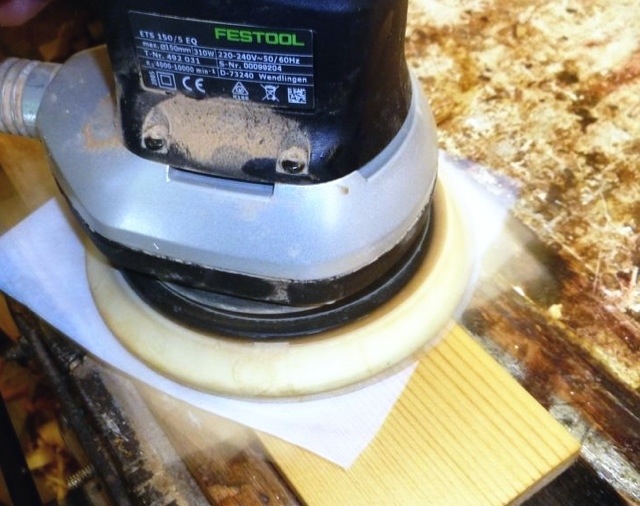
A wet oil finish with an Ets 150/5

The Festool surfix oiler system, part 2

In the previous article on the new Festool oil system I produced a set of samples in both hardwood and softwood to see how easy it was to use the new oil system when following the instructions provided with the kit. Whilst the application method worked I wasn’t happy with having to leave the project for 8 hours between coats, so I thought I’d try the Festool oils using the wet burnishing method which I’ve used extensively with other oil finishes to see how good a finish would result.

For this test I’ll again be turning to my Ets 150/5 sander and the timber I’m using will be Sydney Blue gum for the hardwood sample and Baltic pine for the softwood.

The blue gum is recycled flooring and had already been sanded to about 120 g but the Baltic I have is in rough sawn boards; so once I’d dressed the Baltic,( by hand !) I was ready to begin.
In the Festool method that I wrote about in the previous blog, the samples were only sanded to 320g.
In the wet burnishing method we’ll be using both Festool Brilliant 2 and Titan papers and sanding up to 1500g. To achieve the best finish, It’s very important to remember the basic sanding rules relating to sander speed and grit size when using this method.
Use the table below as a guide to help select the appropriate speed for the grit your using.


Brilliant 2 Abrasives

Grit: Speed:
40. 6

60. 6

80. 6

120. 5

150. 5

180. 5

240. 4

320. 4

400. 3


Titan Abrasives
Grit: Speed:
500. 3

800. 2

1000. 2

1200. 1

1500 & finer 1


This chart is a suggested range only and results can vary depending on the type of timber that you’re using for your project.
If your using a Rotex sander remember to use the Rotex, random orbital technique as described in the “How do I get the best from my Rotex” article which is listed on the main page of this blog. If your using an ETS sander just work carefully though the progressive grades of paper paying close attention to the speed settings on the sander.

Once you’ve reached 1200 grit stop, as now we’re going to apply our first coat of oil. It you haven’t read my previous article on using the Festool oiler system, I’d suggest that you pause here and go back and have a look at it, particularly the section on loading and using the applicator pad.
Once you’ve chosen your oil and have the applicator pad set up apply an even coat of oil to the work piece. Try not to get too heavy a coat as repeated thin applications will give you a far better result than thick coats.
Once applied leave it for no more that 15 minutes then grab your sander with the sheet of 1500 grit Titan paper on it and , with the speed set to 1, begin to sand the surface of the work piece, gently and evenly working the oil into the timber. The small amount of heat generated by this process will open the pore of the timber allowing the oil to penetrate.
Work the oil into the timber for about 5 minutes ensuring that you cover all areas on the workpiece.
Once you’ve done this place a paper napkin on the workpiece, place your sander on top of the napkin, (don’t remove the abrasive) check that the sander is still on speed 1,then gently polish the entire surface of the workpiece. The napkin serves a twofold purpose in this technique. The abrasive properties of the napkin are around 6000 grit which serves to gently burnish the surface whilst the paper absorbs any excess oil from the work.
Put the piece aside for about an hour to give the oil more of a chance to dry then repeat the process from the oil application step, until you’ve achieved the level of finish you’re after.
I’d recommend a minimum of four coats of oil to achieve a good degree of protection , though the more coats you do, the better the final result.
Be sure to leave at least 24 hrs after application of the final coat of oil and give it a final buff using your sander and a paper napkin before you use your piece.

Safety note: Handle all materials with due care and be sure to clean up your work area and wash your hands properly when you have finished using these products. There is always a risk of spontaneous combustion of rags used in oil finishes if not stored correctly. Soak and rags used in water then dispose of in a bin outside your workshop when you’ve finished for the day.
Use all relevant personal protection equipment, ( safety glasses, hearing protection, etc) when using any of the techniques listed on this website.
Work safe, Have fun.

I hope you enjoyed this article and as usual, your comments and questions are always appreciated.

The next series of articles I’ll be posting will cover a the things you need to know about routers

Cheers

Bryan

Blog at WordPress.com.

Up ↑